 Palm Desert Golf Cart Repair
Mobile Golf Cart Repair: Fixed in Your Driveway, Palm Desert CA
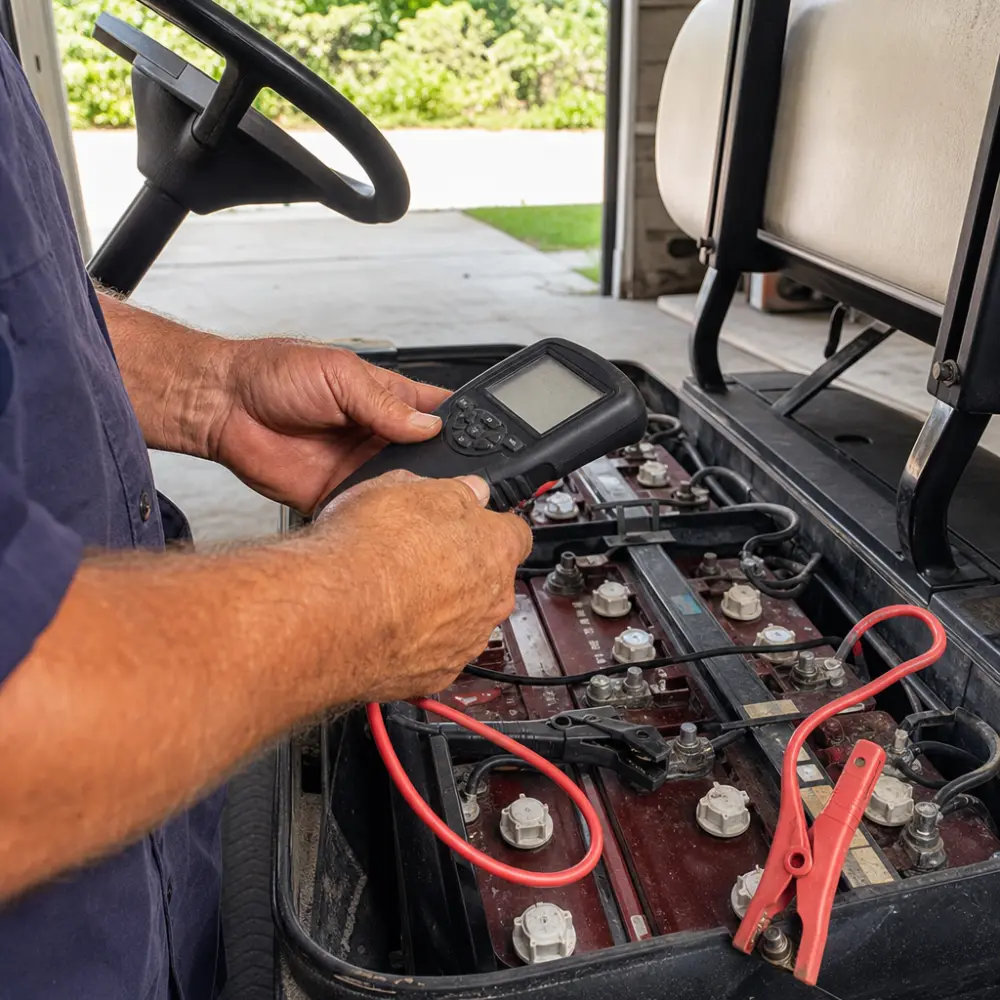
Our techs come to the cart. You call, we drive to your Palm Desert driveway, garage or cart garage with the meters, hand tools and the parts that cover most breakdowns, find the fault where the cart sits, and give you a written price before we turn a wrench. Most repairs get finished during that visit. Nothing gets trailered, and you never have to lift a 60-pound battery.
Below is how a house call actually runs, how we track down a fault, what we can and can’t finish on site, and why home service fits the way people use carts in this part of the Coachella Valley.
A house call, step by step
1. The phone call. This is where most of the diagnosis starts. We ask for the make, the age of the cart and the pack, and what it is doing. “Dead overnight” points somewhere different from “a little slower every week,” and “one click when I press the pedal” points somewhere different again. That conversation decides which parts we load.
2. Access and a window. We set an arrival window and sort out how we reach the cart: gate instructions for a gated community, a code for the cart garage, whether you will be home. Plenty of our Sun City Palm Desert jobs are done with the owner at the clubhouse and a phone call to approve the quote.
3. Testing. Our tech works through the fault with a meter before forming an opinion. The order matters, and it is laid out in the next section.
4. The quote. You get the finding and the price in writing, with the trip and diagnostic charge shown, before any work. If you want to think about it, the cart stays exactly as it was.
5. The repair. With your go-ahead, common repairs happen right then. If a part has to be ordered, we tell you how long it should take and whether the follow-up visit adds a second trip charge, so there is no surprise.
6. The close-out. Before we leave we water any flooded batteries, clean and tighten the terminals we touched, test drive the cart, and talk through disposal of the old parts. Lead-acid cores are worth something, so ask how they are handled in your quote.
How we chase a fault (cheap answers first)
A golf cart that will not go has a short list of causes, and the inexpensive ones are more common than people expect. Our techs check them in roughly this order:
- Connections. A loose, burned or corroded battery cable can make a healthy cart act dead. Valley dust holds moisture against terminals, and a high-resistance joint in a circuit carrying hundreds of amps gets hot and drops voltage. This is often a small job.
- Each battery under load. A pack can read normal sitting still and then collapse the moment the cart pulls away. We load test the batteries one at a time, because one weak unit drags down the rest, and on a young pack replacing that single battery can be the right call.
- The charger. Before anyone blames the batteries on a cart that “won’t charge,” we confirm the charger is actually putting out. Chargers live in hot garages here and fail regularly, and a charge receptacle with a burned pin can look like a dead pack.
- Solenoid and controller. We measure what goes in and what comes out. A solenoid is usually a $100–$250 repair and a controller usually $300–$600, so you want the cheaper part ruled in or out first.
- Motor and wiring. Motor draw, brushes on older series motors, the harness under the floor, the forward/reverse switch.
That sequence is why we give a quote after testing, not on the phone. A cart that sounds like it needs batteries sometimes needs a cable and a charger fuse.
Different carts, different first tests
The service is the same whatever is parked in your garage. The diagnostic path is not.
Club Car. Many DS and Precedent carts manage charging through an onboard computer. When a pack has been run very low, or has sat for months, the charger may never switch on, and the cart looks like it has a failed charger. Getting the pack voltage back up is sometimes the whole fix, and missing that step is a common, expensive misdiagnosis.
E-Z-GO. We ask whether it is a TXT or an RXV before we arrive. The RXV runs an AC drive with an electromagnetic motor brake; the older carts run a series or separately excited DC system. A “won’t move” complaint takes a different route on each.
Yamaha. The Drive and G-series carts are wired plainly, and most of their faults land in the usual pack, charger and solenoid group.
ICON, Evolution and other newer carts. Many come with factory lithium. That shifts the conversation away from watering and toward the battery management system, which can shut the pack off to protect itself. Much of the rest of the running gear uses standard parts.
The job list for a driveway visit
What we routinely finish at your house:
- Battery packs, lead-acid sets and lithium conversions. This is our most frequent large job. More on the battery replacement page.
- Chargers and charge ports, which account for a large share of “won’t charge” calls. See charger repair.
- Solenoids, the classic click-and-nothing fault.
- Controllers and motors, tested properly first; see motor and controller repair.
- Brakes, from adjustment to shoes, cables and drums; see brakes and tires.
- Tires, including the turf tires Sun City Palm Desert courses expect, mounted at your home.
- Lights and wiring, from corroded cables to the headlamps, taillamps, reflectors and mirrors a cart needs for street use.
- Annual service, our tune-up, which is the cheapest way to avoid every item above.
What we do not do on site: frame straightening or welding, and complete gas engine rebuilds. They are rare, and when one comes up we say so.
Why home service fits Palm Desert
In much of the country a golf cart is something you take to the course. Here it is often how you get to the course, the pool, the fitness center and the neighbors’ house. Palm Desert has run a golf cart transportation plan since 1993, now Municipal Code chapter 10.76, which lets permitted carts use streets posted 25 mph or less and the designated cart routes during daylight hours. Sun City Palm Desert and the country club communities build daily life around carts the same way. Our street-legal guide covers the permit, the hours and the equipment; check the current rules with the city before you rely on them.
That has a practical consequence when a cart quits. The household that uses it as a second car usually has no trailer, often no hitch, and no easy way to move a vehicle that will not roll. Getting a dead cart to a shop turns into a project involving a borrowed truck, a ramp and a couple of strong friends. A house call skips all of it, and the communities here sit close together, so the drive to reach you is rarely long.
The season that breaks carts here
Breakdowns in the valley follow the calendar. Summer afternoons can pass 115 degrees, and a closed cart garage gets hotter. That heat drives water out of flooded lead-acid batteries, speeds the aging of the plates, and cooks chargers. On top of the heat comes the summer absence: many owners leave from roughly May to October, and a cart that sits at a falling state of charge in that garage sulphates. When the owner returns in the fall, the pedal does nothing.
So October and November bring our busiest weeks, and a large share of those calls are carts that were fine in spring. Two habits head most of it off:
- A spring check before you leave. Water levels, a load test, clean terminals, brakes. Our tune-up service does exactly that, and it usually runs $100–$200.
- A plan for the empty months. Charged fully before you go, watered after charging, and either kept on a charger meant for storage or checked by someone partway through. If you leave every summer, lithium deserves a serious look because it has no electrolyte to lose and discharges far more slowly.
Our article on what valley heat does to a battery pack explains the chemistry, and the sat all summer page covers what we try first on a cart that died while you were away.
Where we drive
Palm Desert and Sun City Palm Desert are the center of our route. We also run house calls to Indian Wells, Rancho Mirage, La Quinta and Indio. Each of those pages covers the local details that change a repair, from gated access to the communities’ own cart rules.
A few honest limits
We are an independent repair company. We are not an authorized dealer or warranty center for Club Car, E-Z-GO, Yamaha, ICON, Evolution or any other maker. If your cart is new enough that the fault might be covered, check with the dealer who sold it before paying anyone, us included; we would rather tell you that than bill you for a warranty job.
Our pricing page lists typical ranges for the common repairs, and the repair cost calculator gives you a ballpark before you call. Your actual price comes after our tech has tested the cart, in writing, before work starts.
Booking a house call
Mobile repair around Palm Desert means a technician who comes to the cart instead of asking you to bring the cart to us. Call or use the form, tell us the make, the battery age and what the cart is doing, and how we get to it. We will give you an arrival window that fits the week’s route, test the cart where it stands, and show you the price before any work begins.
Frequently Asked Questions
Which repairs can you finish at my house, and which can't you?
Most of them. Battery packs, lithium conversions, solenoids, controllers, chargers and charge receptacles, brake shoes and cables, tires, belts, wiring and lights are all driveway jobs for us. The exceptions are structural frame repair and a full engine teardown on a gas cart; if your cart needs one of those, we tell you plainly instead of attempting it on your garage floor.
Does someone have to be at the house while you work?
Not always. If we can get to the cart (a gate code, an unlocked cart garage, a side yard) and we can reach you by phone to go over the quote, our tech can do the job while you are out. Tell us how access works when you call so nobody waits at a locked gate.
How soon can a tech get to me?
It depends on the week. We give you a window when you call, based on the schedule and on where you are. Palm Desert and Sun City Palm Desert are the core of our route; Indian Wells, Rancho Mirage, La Quinta and Indio are farther out and can take longer to fit in. If the cart is how you get around, say so.
What do you need to know before the visit?
The make, roughly how old the cart and the batteries are, the pack voltage if you can read it off the charger, and the symptom in your own words. A cart that hums but does not roll and a cart that goes dead halfway home are different jobs, and knowing which one we are driving to decides what goes on the truck.
Is a house call priced higher than taking the cart to a shop?
Our published ranges sit in line with shop work in the valley, and you avoid renting or borrowing a trailer. There is a trip and diagnostic charge, and we explain up front how it applies if you go ahead with the repair. Ask us to confirm that on the phone before we come out.
Do you work on more than one brand?
Yes. Club Car, E-Z-GO, Yamaha, ICON, Evolution and most of the others parked in valley garages. The brand changes which test we run first, not whether we can come. Club Car's onboard charging computer, E-Z-GO's RXV motor brake and the factory lithium on many newer carts each have their own quirks.
Can my cart's roof be lowered to clear the garage door?
Often. The usual approach is a lowering kit that cuts each metal strut at an angle and joins it with corner brackets, bringing the roof down roughly 5 inches. Those kits are built for carts with 1-inch square metal struts, and their makers list the Club Car Precedent and the Yamaha Drive (G29) and Drive2 as not compatible, so those need a different top or custom strut work. The cuts are permanent: measure the door, the cart and the headroom you can accept first, and check whether a strut-mounted windshield still fits.